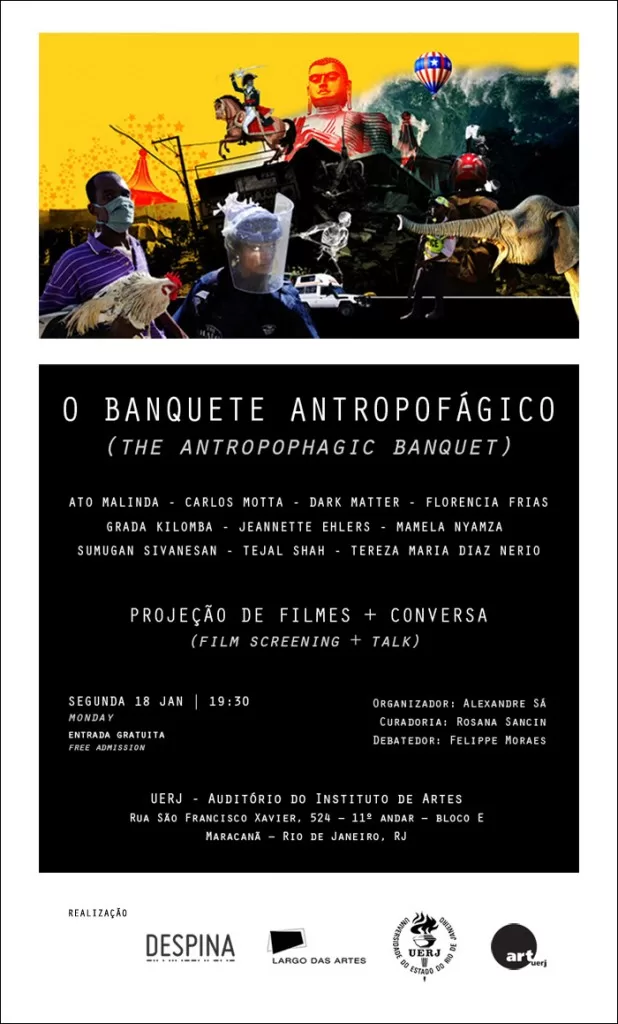
Group Exhibition
"Borders, Barriers, Walls" at Monash University Museum of Art (MUMA), Melbourne, April 30-July 2, 2016
Borders, Barriers, Walls
CURATOR
Francis E. Parker
ARTISTS
Lawrence Abu Hamdan, Allora & Calzadilla, Karen Black, Gunter Christmann, Jin Chul Kyu, Guan Wei, Shilpa Gupta, Khaled Hourani, Raafat Ishak, Isaac Julien, Sonia Leber & David Chesworth, Kai Löffelbein, Ricky Maynard, Carlos Motta, Tony Schwensen, Amy Spiers & Catherine Ryan, Danae Stratou and Judy Watson
Borders, barriers and walls delineate this group exhibition of Australian and international artists. It reflects on how these contested and complex forms shape the world, producing situations of separation, isolation or thwarted passage across the globe. Whether they be physical constructions, psychological constructs or natural defences, the exhibition considers the forces by which these divides are either upheld or breached. Borders, Barriers, Walls features more than thirty artworks ranging from video installation, painting, photography and sculpture. The exhibition includes a new commission by local artists Amy Spiers and Catherine Ryan.
The exhibition will be accompanied by a catalogue featuring commissioned essays by Professor Gillian Triggs, President of the Australian Human Rights Commission, and Yanis Varoufakis, founding member of the Democracy in Europe Movement 2025 and former Greek finance minister, along with a curatorial overview by Francis E. Parker.
more info here
Solo Exhibition
Beloved Martina... at Mercer Union, Toronto, April 14- June 5, 2016
Carlos Motta: Beloved Martina…
14 April 2016 - 4 June 2016
Opening Reception 14 April 2016 7pm
Mercer Union is delighted to present the exhibition Beloved Martina… by artist Carlos Motta including works by Arisleyda Dilone, Pidgeon Pagonis and Del LaGrace Volcano.Artist Talk: Thursday 14 April 2016, 6.30PM
Carlos Motta is a multi-disciplinary artist whose work draws upon political history in an attempt to create counter narratives that recognize suppressed histories, communities, and identities. Motta has an ongoing preoccupation with democratic representation and the repression of individual and collective civil liberties. Promoting the act of self-representation, he creates works that question the writing of history, the construction of political memory, and the normative discourses of sexuality and gender.
Beloved Martina…, Motta’s first solo exhibition in Canada, presents a series of works that reflect on the restrictive nature of the gender binary and its own mythologizing forces, and focuses on the historical and ongoing repression of intersex identities. Presented in the front gallery, Motta’s mesmerizing film Deseos/تابغر [Desires] (2015) forms the starting point of the exhibition. Weaving across expanses of water, land, history, language, and cultures, the film traces the epistolary correspondence of two women at the beginning of the nineteenth century, one in Suesca, Colombia, and the other in Beirut, to engage with the social, political and epistemological possibilities of desire. Deseos/تابغر narrates the stories of Martina who was prosecuted for being a “hermaphrodite” and of Nour, a woman who is forced to marry her female lover’s brother. The intimate communication between the two women reveals the ways in which medicine, law, religion, and cultural tradition shaped dominant discourses of the gendered and sexual body.
Parallel to this video installation, in the back gallery, Motta presents a new series of 3D sandstone prints that depict the mythological figure of the “hermaphrodite,” based on sculptures from Greek and Roman antiquity and the Renaissance, and photographs from the late nineteenth century. Exhibited in a museum-like installation, the sculptures confront the institutional drive to classify and define with its authoritative gaze. Motta’s layering of stories is not just contained within the past: included in the exhibition are a series of video portraits part of Motta’s oral history project Gender Talents (2015) where intersex activists Jim Ambrose, Tiger Devore, David Iris Cameron, Hida Viloria and Sean Saifa M. Wall speak of their battles around advocating for the recognition of intersex identities and politics.
Presiding over the gallery is Self-Portrait: Blue Beard (1996) by Del LaGrace Volcano, a photographic self-portrait that defies viewers’ assumptions and expectations about gender performance and expression. Also included is Arisleyda Dilone’s film Mami y Yo yi mi Gallito (2015) which focuses on the vulnerable relationship between a mother and her intersex daughter and Pidgeon Pagonis’ photographic series Children’s Memorial Hospital Killa [CMHK] (2015) that depicts their singular protest in front of the hospital where they underwent numerous medical procedures as “corrective” measures during their childhood.
From semi-fictional to historical representation to self-representation, Beloved Martina…layers narratives of past and present to question gender norms, desires and the potential of real freedom through a politics of self-representation, resistance and critical difference.
This exhibition is co-presented in partnership with the Images Festival, April 14 – 23, 2016. For more information visit imagesfestival.com
With special thanks to Objex Unlimited
Deseos/تابغر [Desires] (2015) was commissioned and produced by Council (France) and co-produced by Hordaland Kunstsenter (Norway), MALBA, Museo de Arte Latinoamericano de Buenos Aires (Argentina), Röda Sten Konsthall (Sweden), Galeria Filomena Soares (Portugal), Mor.Charpentier Galerie (France) and with further support from Ashkal Alwan (Lebanon), DICRéAM (France) and the Göteborg International Biennal for Contemporary Art (Sweden).
more info here
Solo Exhibition
Deviations at PPOW Gallery, April 21-May 21, 2016
Carlos Motta Deviations
April 21 – May 21, 2016 Opening Reception: Thursday, April 21, 6-8 PM
Video plays on loop every half hour starting at 10:00 AMCatalog Available with Essay by David Getsy, Goldabelle McComb Finn Distinguished Professor of Art History at the School of the Art Institute of Chicago
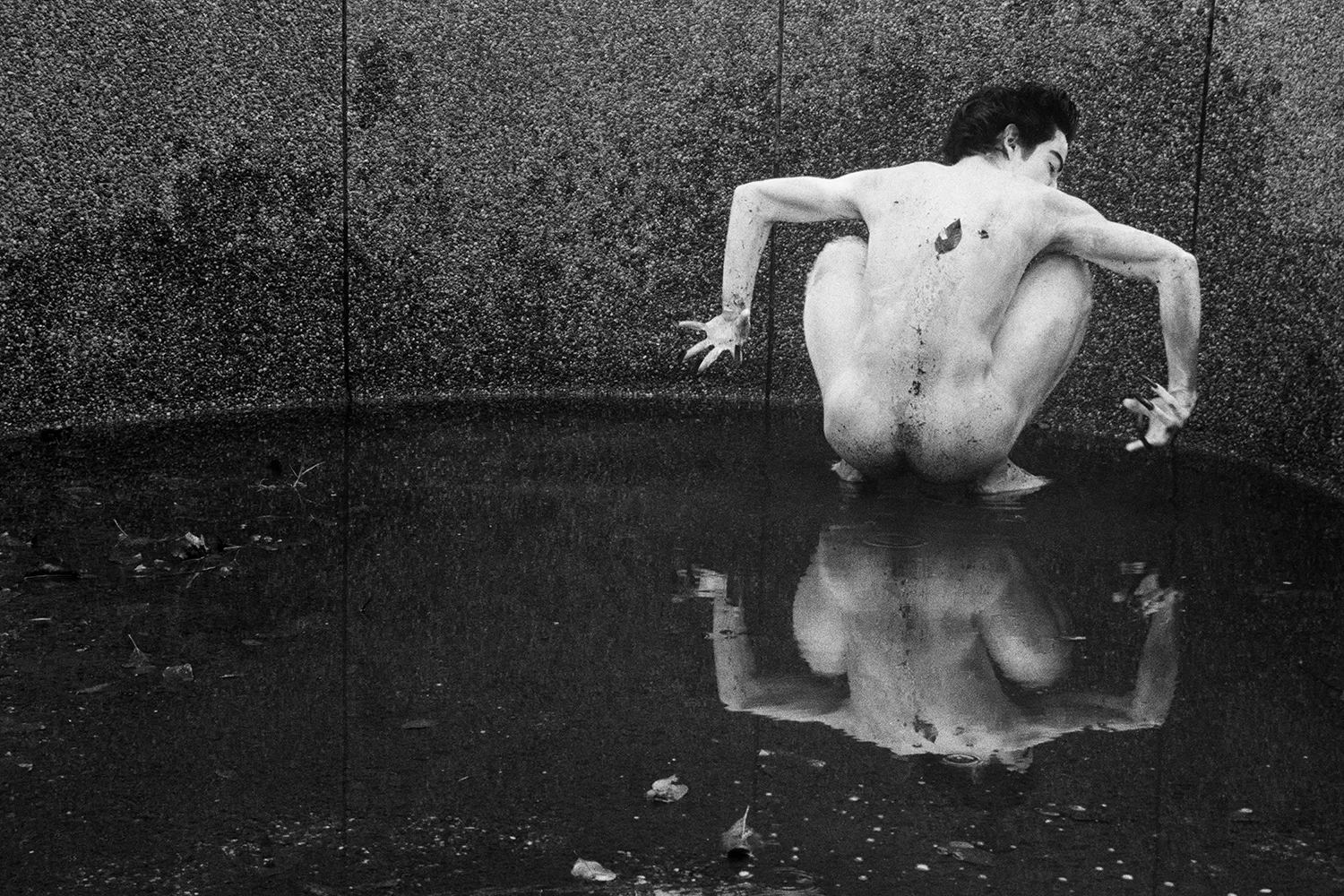
P•P•O•W is pleased to announce Deviations a solo exhibition by Carlos Motta, the artist’s first exhibition with the gallery. An internationally renowned artist whose work has been on view at notable museums and biennials around the world, this exhibition marks his first major gallery exhibition in New York. Motta is a multi-disciplinary artist who creates installations, films, photographs and sculptures that take as their subject political and historical events, which Motta explores from unexpected angles, proposing new readings and counter-narratives. Interested in gender, sexuality, and the way minority communities are represented, Motta has developed a practice that mines the past to offer a critical re-reading of the present. The exhibition at P•P•O•Wwill feature three works that span the arc of Motta’s career from 1998-2015.
Among the works on view will be Motta’s 2015 film Deseos / رغبات (Desires), which features a trans-historical correspondence between two women – Martina, who lived in Colombia during the late colonial period of the early 19th century and was tried for being a ‘hermaphrodite,’ and Nour, a woman from Beirut during the late Ottoman Empire who marries her female lover’s brother in an attempt to save her love. The film poetically exposes the ways in which the categories of gender and sexuality were dutifully constructed by scientific, legal, and religious discourses.Deseos / رغبات was co-written by Motta and Lebanese anthropologist Maya Mikdashi and commissioned and produced by Council (France) and co-produced by Hordaland Kunstsenter (Norway), Museo de Arte Latinoamericano de Buenos Aires (Argentina), Röda Sten Konsthall (Sweden), Galeria Filomena Soares (Portugal), Mor.Charpentier Galerie (France) and with further support from Ashkal Alwan (Lebanon), DICRéAM (France) and the Göteborg International Biennal for Contemporary Art (Sweden).
The exhibition will also present the 2014 installation of sculptures Towards a Homoerotic Historiography, an astonishing representative of Motta’s research on pre-Hispanic and colonial sexualities. The installation features 20 miniature gold-washed silver figures, all copies of sculptures created by indigenous groups in the Americas before the conquest. Displayed in museum-like vitrines, the pieces depict acts of homoerotic sex. The installation reflects on the ongoing censorship these objects have been subjected to by the social sciences and encourages a removal of the Christian values that have been imposed on them in order to reconsider of the role the body, desire, and pleasure may have played in ancient cultures.
Also on view will be a 1998 untitled series of photographic self-portraits, which feature Motta performing fictive characters for the camera in eerie, constructed landscapes. The images depict scenes where his body, sex, and gender are malleable props, transformed beyond recognition. In these early photographs – which have never been shown in a formal exhibition – Motta experiments with the representation of sexual alterity, the elasticity of identity, and the politics of difference, unknowingly anticipating the themes that he engages in his current practice.
In the words of David Getsy, who has contributed an essay to the exhibition’s catalog, Motta’s work “…is lyrical and ambitious, and he conjures historical characters that are complex in their agency and in their resistance to the systems of political and cultural power that sought to locate and control them. Motta creates moments of what one could call visionary identification.”
Text
Activism, Visuality, and the Needs of Queer Youth by Carlos Motta, Journal of Visual Culture, April 2016
Activism, Visuality, and the Needs of Queer Youth by Carlos Motta
As LGBTI issues become visible within society there is a growing belief that society is ready to confront prejudices around sexuality and gender. But who is represented in these processes of visualization? The LGBTI agenda has focused on the defense of marriage, Don’t Ask Don’t Tell, federal hate crime statutes and the Employment Non-discrimination Act. The political strategy around these issues has been defined by a moderate approach based on demanding inclusion into existing institutions. A look at the normalization of sexual politics reveals that minorities remain at the margins. I approached activists from QUEEROCRACY and immigration activist Felipe Baeza to discuss: What are the social issues young people care about ? What forms of activism do young people favor and what motivates them to organize? What forms of visuality do young queer activists use and how do these relate to the strategies of the previous generations?
read full text hereEssay
The art practice of Carlos Motta and the archive as a tool for re-enactment and communication
The art practice of Carlos Motta and the archive as tool for re-enactment and communication by Stefanie B. Kogler School of Philosophy and Art History, University of Essex, Colchester, UK Abstract This essay discusses the practice of contemporary, multidisciplinary artist Carlos Motta (Colombia/USA), who explores history, politics, religion, sexuality, and gender in the context of today’s democracy, and from the view of side-lined groups and their subjective views. Approaching this topic from a distinctly leftist political field, Motta critiques democracy as a political framework that imposes the rule of the majority upon minorities, who are obliged to adhere to hegemonic norms that determine their way of economic, social, and political engagement. Motta’s strategy traverses extensive research and the formation of online archives through which he establishes carefully curated repositories that critique power relations and the hegemony of the majority. He furthermore, uses documents from the archive to reenact and re-contextualize historical events in contemporary settings. This multifaceted approach contributes to the creation of multiple voices that are in dialogue with each other. As a result, the artist’s practice underlines the significance of archives and their contingency for the future, as well as their potential to provoke change. This essay argues that Motta uses the archive as a tool for communication and impetus for action. Through this artist’s contribution to contemporary art, he unearths pressing issues concerning unequal power relations, opening avenues for discussion and debate.
Group Exhibition
(SIGNAL) at Smack Mellon, March 5 – April 17, 2016
Smack Mellon Artists’ Reception: March 5, 6 – 8 pm Jess T. Dugan, Anahita Ghazvinizadeh, Nicki Green, Rhys Ernst & Zackary Drucker, Young Joon Kwak, Carlos Motta, Cobi Moules, Chelsea Thompto, Gil Yefman, Rona Yefman (SIGNAL), curated by Alexis Heller, opens at Smack Mellon on March 5 and will be on view through April 17, 2016. This exhibition presents artworks that challenge the gender binary and explore a continuum of self-definition. Working in diverse mediums, these eleven contemporary artists utilize code, collaborative representation, fantasy and play to subvert histories that have denied gender variance. They question authorship over ‘the natural’, make manifest sites of resistance, and reimagine a future where identities are fluid, becoming ad infinitum and celebrated as such. (SIGNAL), written in a binary code created by Chelsea Thompto, translates into the word SIGNAL. The exhibition’s title begins communication around what happens when the gender binary becomes illegible. In the absence of fixed gender markers, where can we start to understand each other and how do we make ourselves known? The code, and works in dialogue as part of (SIGNAL), resists the ability to take a ‘quick read’ and requires a more complex process of discovery. By engaging history, acts of defiance, real experiences of violence, and imagination, a more nuanced language of gender possibility emerges. Nicki Green, Cobi Moules and Gil Yefman renegotiate the past’s treatment of transgender bodies by mining cultural, artistic and religious traditions and symbols and recalibrating them to highlight empowered narratives. Nicki Green’s ceramic vessels and quilted hankies picture androgyny and transformation as divine, with imagery from Jewish mythology and queer code. Paintings from Cobi Moules’ series Bois Just Wanna Have Fun, portray self-portraits of the artist in multiples, playing in stunning wild landscapes. The works significantly integrate his trans body in the natural, a response to the ideologies of his conservative Christian upbringing and the Hudson River School. Gil Yefman also shifts cultural messages about androgyny, with his large knitted sculpture, sound piece and performance, Tumtum. Translated in Jewish law and modern Hebrew to mean ‘unclean’ or ‘stupid’, Yefman instead presents a corporeal being that is at once monstrous and magnetic. Jess T. Dugan, Rona Yefman, Carlos Motta, and Chelsea Thompto explore active resistance to gender norms and moments of solidarity and brutality faced as a result. Jess T. Dugan’s intimate portraits redefining masculinity reflect on how connections with others help us author our own identity. In her multimedia project spanning 14 years, Rona Yefman documents her brother Gil’s transition, from male to female and then beyond gender, and their fantastical relationship that helped bolster their survival. Carlos Motta’s video portraits of transgender and intersex activists expose the powerful organizing, advocacy, and education efforts of gender self-determining communities and the perilous conditions that make their work vital. Chelsea Thompto’s expansive piece, Trans Effigy 2015, comprises code written in charcoal on the wall, along with wooden sculptures. Given a key to decipher it’s meaning, viewers are engaged in a slow dialogue around deconstructing the gender binary, how we relate to others’/othered bodies, and violence. Anahita Ghazvinizadeh, Young Joon Kwak, and Rhys Ernst and Zackary Druckerenvision worlds where identities and everyday systems are slippery. In her short film,When the Kid was a Kid, Anahita Ghazvinizadeh looks at the flux of children’s gender performance and cultural expectations, through a role-playing game set in Tehran. Young Joon Kwak destabilizes held constructs with her reimaging of the icon of feminine beauty, Venus. Her Venus is reborn formless and without discernible identities, opening space for boundless new interpretations of personhood and desire. Rhys Ernst and Zackary Drucker coalesce transgender histories, time and space in their film She Gone Rogue, in an interrogation of our ever shifting bodies and selves and the deep value of intergenerational wisdom and chosen families. The artworks in this show, much like gender itself, present layered, complicated, and often playful ideas about embodiment. (SIGNAL) enters an ongoing conversation on the failures of the gender binary and what is reclaimed, endured and gained in the move to live beyond it.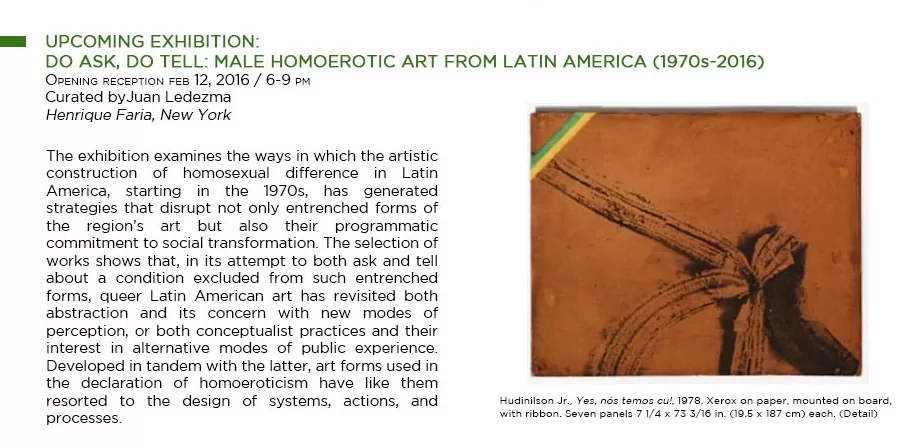
Group Exhibition
Do Ask, Do Tell: Male Homoerotic Art from Latin America (1970s-2016) at Henrique Faria Fine Arts, New York, 2/12-3/12
more info here
Symposium
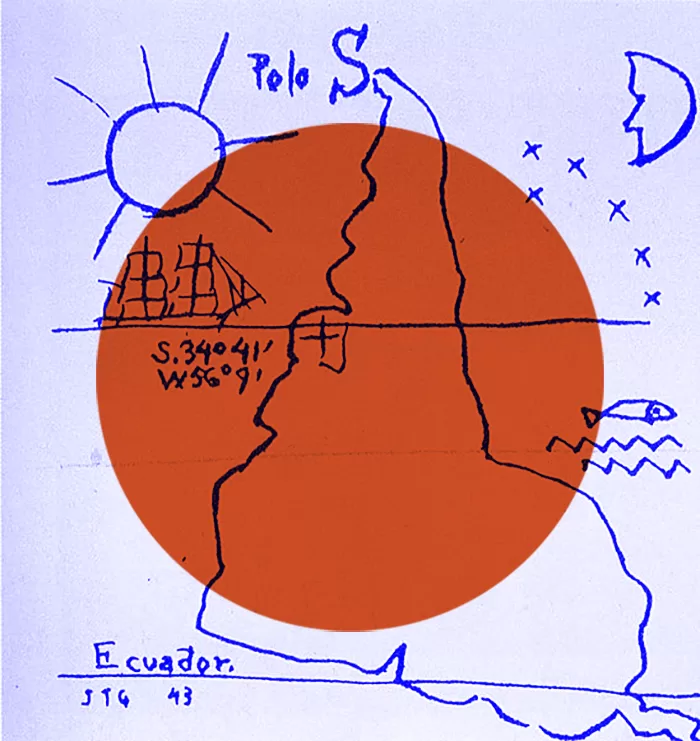
“La universidad desconocida," Museo Jumex, Mexico City, January 29-30
SIMPOSIO: LA UNIVERSIDAD DESCONOCIDA 29.ENE - 30.ENE / 3-7PM El simposio La universidad desconocida es parte del programa público que acompaña la exposición BAJO UN MISMO SOL: ARTE DE AMÉRICA LATINA HOY en el Museo Jumex. A su vez es un ejercicio de reconocimiento a las diversas plataformas de discusión recientes que buscan repensar el arte en América Latina y sus condiciones de producción. Propone un formato de diálogo que alude a una universidad constituida por aquéllos que han revisado y reformulado, a través de la escritura, la teoría y la curaduría de exposiciones, el lugar que ocupa actualmente la producción artística en América Latina dentro de un ámbito global. El simposio abarcará también el estudio y presentación de prácticas disidentes y estrategias antropofágicas, explorando las diversas tensiones que intervienen en ese espacio común situado bajo un mismo sol.